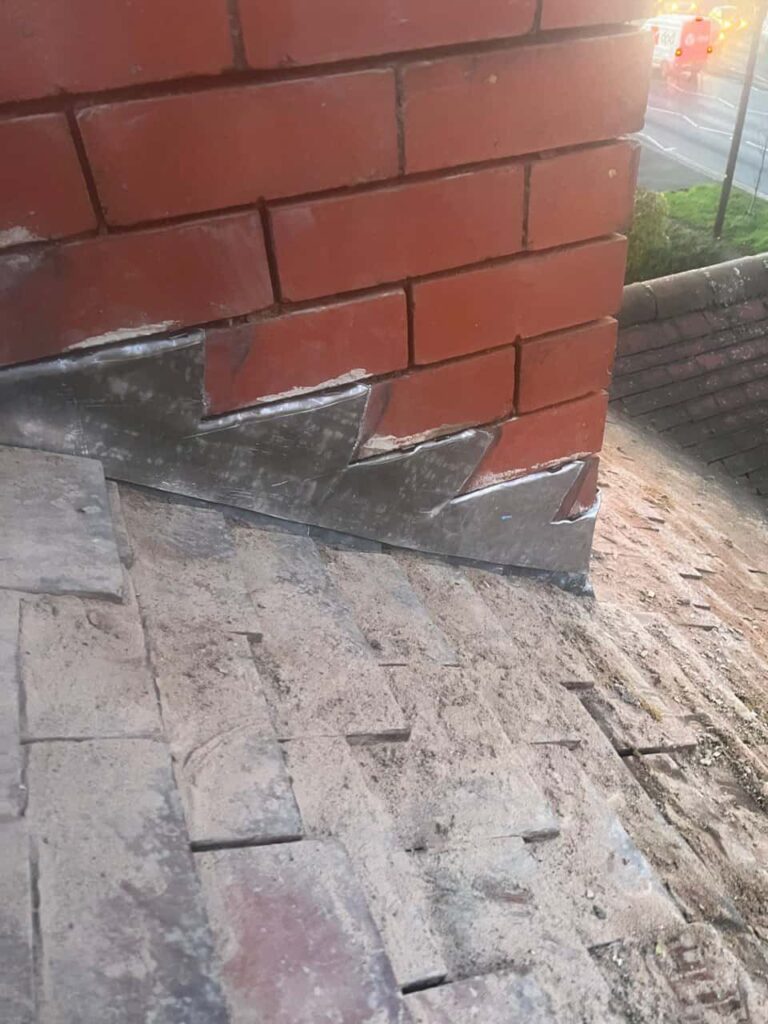
Chimneys and leadwork form some of the most exposed and technically important parts of a roof. They must withstand wind, driving rain and repeated changes in temperature while protecting the junctions where different materials meet.
Severe weather does not always cause dramatic or immediately visible damage. It can loosen flashing, disturb chimney components or expose weaknesses that had already been developing. An inspection helps identify these defects before further rainfall allows moisture to spread into the surrounding roof.
How Can Severe Weather Affect Chimneys and Leadwork?
A chimney passes through the roof covering, creating several junctions where water must be carefully directed away. Lead flashing is commonly used around these areas because it can be shaped to form a weather-resistant connection between the chimney and roof.
After severe weather, an inspection should consider:
- The condition of the lead flashing
- Joints between lead and masonry
- Chimney pointing and brickwork
- Flaunching around chimney pots
- The stability of chimney pots and cowls
- Tiles or slates beside the chimney
- Back gutters and drainage channels
- Internal signs of moisture
- Previous repairs around the stack
A defect in one component can affect several adjoining materials, so the area should be assessed as a complete system.
Strong Winds Can Lift Lead Flashing
Lead flashing is shaped and fixed to remain secure while allowing for natural thermal movement. Strong winds can catch a loose edge and lift it away from the roof covering or chimney.
Even a small change in position may create an opening for wind-driven rain. The lead may appear to settle back afterwards, making the disturbance difficult to identify from ground level.
If the flashing was already loose or poorly fixed, severe weather can worsen the defect. A close inspection can establish whether it remains correctly dressed, secured and sealed into the masonry.
Driving Rain Can Expose Weak Joints
Ordinary rainfall usually flows down the roof in a predictable direction. During severe weather, wind can force rain sideways and upwards beneath vulnerable edges.
This may reveal weaknesses around:
- Stepped flashing along the chimney sides
- Apron flashing at the front
- Back gutters behind the stack
- Mortar joints where lead enters the masonry
- Tiles or slates immediately beside the chimney
A junction that appears adequate during light rain may allow water through when exposed to a different wind direction. Dampness after a storm does not necessarily mean the nearest visible tile is responsible.
Chimney Pointing Can Become Loose
Mortar joints bind the chimney bricks together and help prevent water from penetrating the structure. Ageing pointing may already contain fine cracks before severe weather arrives.
Heavy rain can saturate these weakened joints, while strong winds place additional pressure on the stack. Loose mortar may then break away or allow moisture deeper into the masonry.
Failed pointing can sometimes cause dampness that resembles a flashing defect. Both areas should therefore be examined rather than assuming the leadwork is the sole source of the problem.
Flaunching May Crack or Deteriorate
Flaunching is the mortar surrounding the base of chimney pots. It helps secure the pots and sheds water away from their bases.
Severe weather can reveal existing cracks or cause weakened sections to loosen. Water may then collect in damaged areas and enter the top of the chimney structure.
The pots themselves should also be checked for movement or damage. A sound-looking chimney stack may still have defects at its highest and least visible point.
Back Gutters Can Become Blocked
The area behind a chimney interrupts the normal downward flow of rainwater. A back gutter or similar detail directs water around the stack and back onto the roof.
Leaves, moss and wind-blown debris can collect in this confined space during severe weather. If water cannot escape freely, it may build up and pass beneath nearby tiles or flashing.
Clearing the obstruction is important, but the lining and surrounding materials should also be inspected for damage caused by prolonged water retention.
Nearby Tiles or Slates May Have Shifted
Wind pressure around a chimney can behave differently from airflow across an open roof slope. Turbulence may loosen tiles or slates beside the stack even when the wider roof appears unaffected.
A displaced unit can reduce the intended overlap and expose the underlay. It may also leave the edge of the flashing unsupported or create a channel through which water can travel.
The inspection should extend beyond the chimney itself to include the adjoining courses and the fixings beneath them.
Water Can Travel Away From the Chimney
A damp patch near a chimney breast strongly suggests a problem around the stack, but the visible moisture does not always sit directly below the point of entry.
Water can move along the underside of leadwork, underlay, battens or roof timbers before reaching an internal surface. The source may therefore be higher or further across than expected.
Professional leak detection follows the likely water path and compares internal evidence with the external roof details. This helps avoid repairing the wrong joint or overlooking a defect behind the chimney.
Damage May Remain Hidden Until the Next Rainfall
Some storm-related defects do not produce immediate leakage. The underlay may temporarily redirect small amounts of water, or the next rainfall may approach from a less exposed direction.
Warning signs can include:
- New dampness near the chimney breast
- Water marks on ceilings or roof timbers
- Loose mortar around the property
- Visible lifting or rippling in the lead
- Displaced tiles beside the stack
- Debris collecting behind the chimney
- Damp patches that appear only in driving rain
The absence of an immediate leak does not confirm that every junction remains sound.
Why Prompt Inspection Is Valuable
Checking chimneys and leadwork after severe weather can identify localised deterioration while repairs remain focused. It also helps distinguish new storm-related damage from older defects that the weather has exposed.
A professional assessment may determine that the area remains fully serviceable. Where a defect is found, the work can be based on its actual cause, whether this involves securing leadwork, renewing a mortar joint, clearing a back gutter or repairing adjacent roof coverings.
For properties in South Cave, East Riding of Yorkshire, inspecting these exposed roof details can help maintain reliable weather protection following periods of severe weather.
Conclusion
Chimneys and leadwork should be inspected after severe weather because strong winds and driving rain can loosen flashing, expose weak mortar joints, block drainage paths and disturb surrounding tiles. Many of these defects are small and difficult to see but can still create a route for water ingress.
A methodical inspection checks the complete chimney junction rather than concentrating on one visible component. TRP Roofing South Cave provides professional chimney, leadwork and roof inspection services in South Cave, East Riding of Yorkshire. If you have concerns following severe weather, contact the team to arrange an assessment.
Call us on: 01430 330 099
Click here to find out more about TRP Roofing South Cave
Click here to complete our contact form and see how we can help with your roofing needs.